AI content plan generator for social media beginners
A content plan is a publishing schedule where you know in advance what goes out on each day. The Genosai agent asks a few questions about your business, proposes rubrics, builds a table covering two to four weeks and then writes the first posts for you. No experience with AI tools is needed, you answer in plain words.
Updated: August 10, 2026
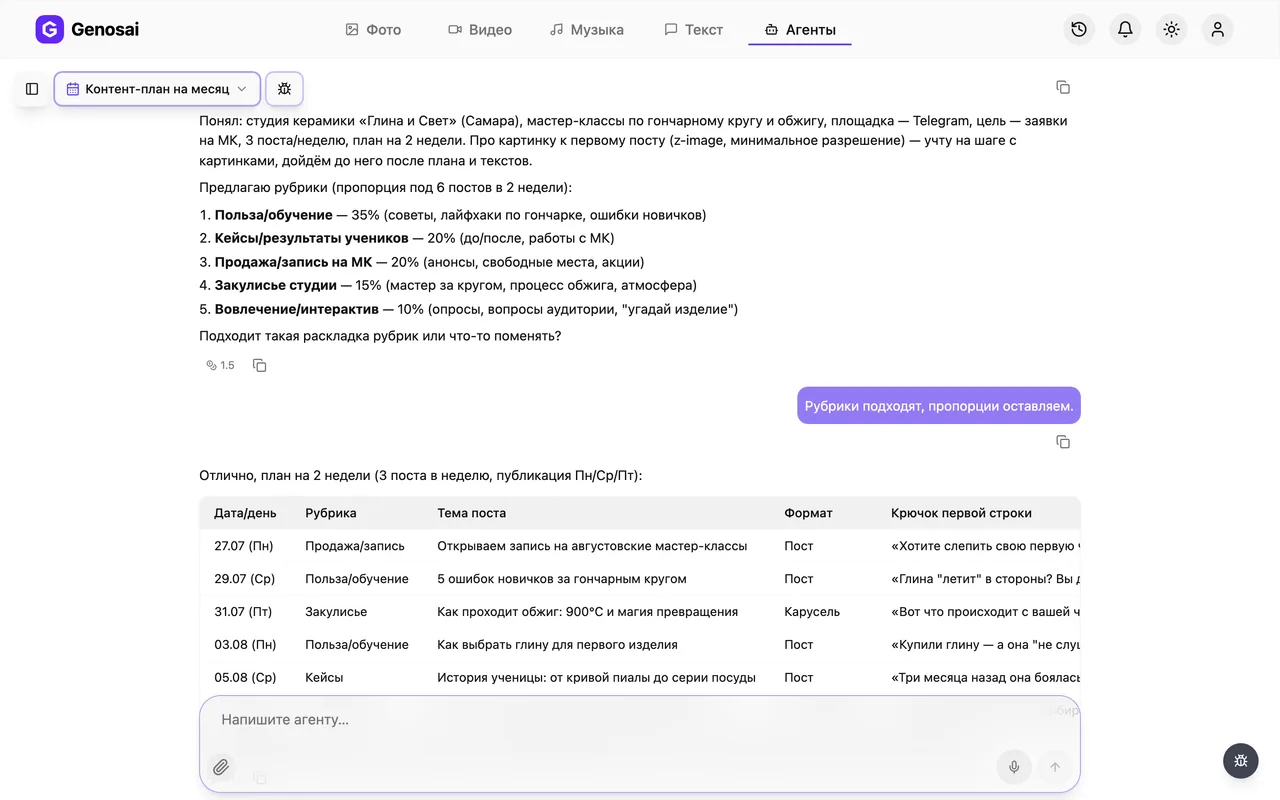
- A month in one table — Day, rubric, topic, format and opening line for every post are collected into a single readable table.
- Balanced rubrics — Content is split between advice, cases, selling and behind the scenes, so the feed never becomes pure advertising.
- Ready-made hooks — Every topic already has its first line, so writing a post never starts from a blank page.
- First posts included — The agent writes up to three publications from the plan right in the chat so you can start today.
- Images for the posts — On request it draws illustrations for the chosen posts in one shared style in a single run.
- Estimate before charging — The cost of the images is shown in advance and nothing is deducted until you press confirm.
What it produced

Step-by-step guide
1. Step 1. Register
Open the Genosai site and press the sign-in button. You can register with an email address or an account you already use. New users receive trial credits, so the plan itself usually costs nothing to build.

2. Step 2. Enter the studio
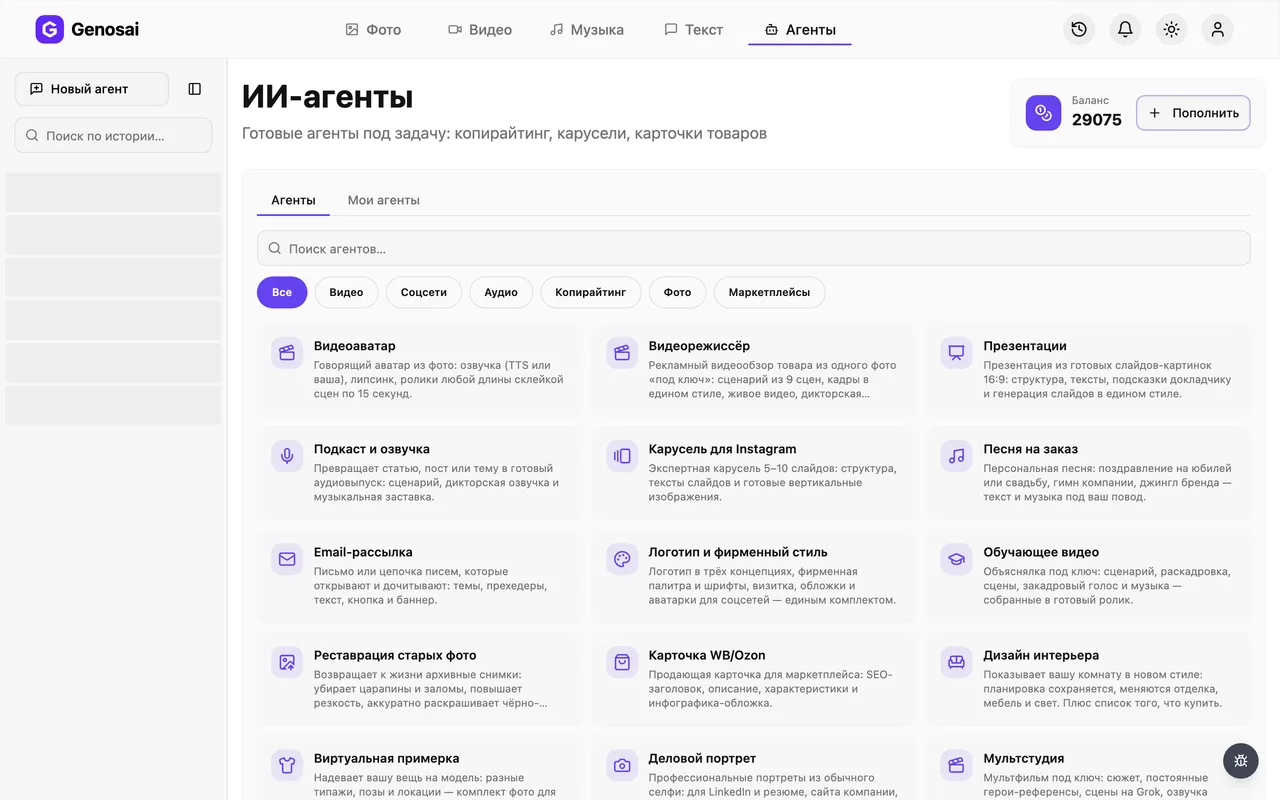
Signing in opens the studio, the main workspace of the service. Near the top sits an Agents tab. An agent differs from plain generation because it walks you through the job and asks the questions itself. Click that tab.
3. Step 3. Find the content strategist
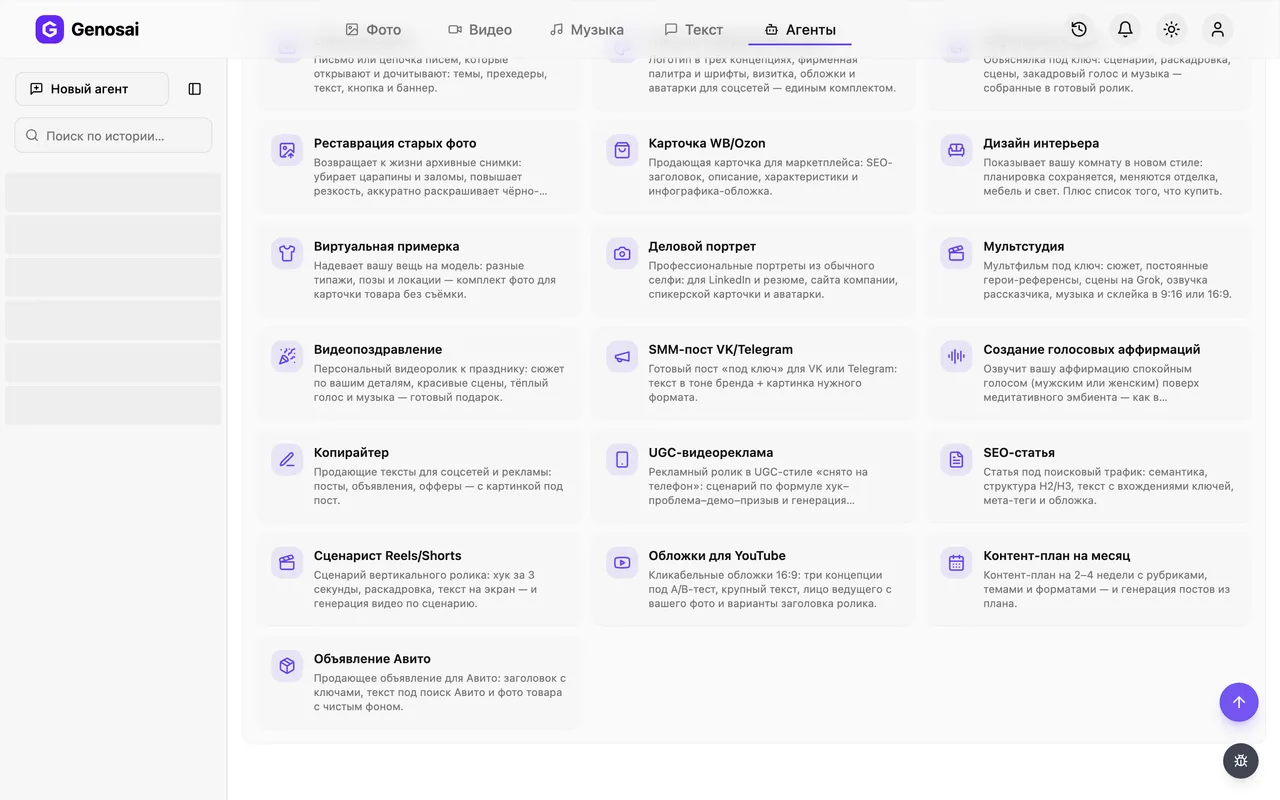
A gallery of helpers grouped by category appears. Choose the social section or type content plan into the search box. Click the card for the monthly plan and a chat window opens.
4. Step 4. Read the greeting
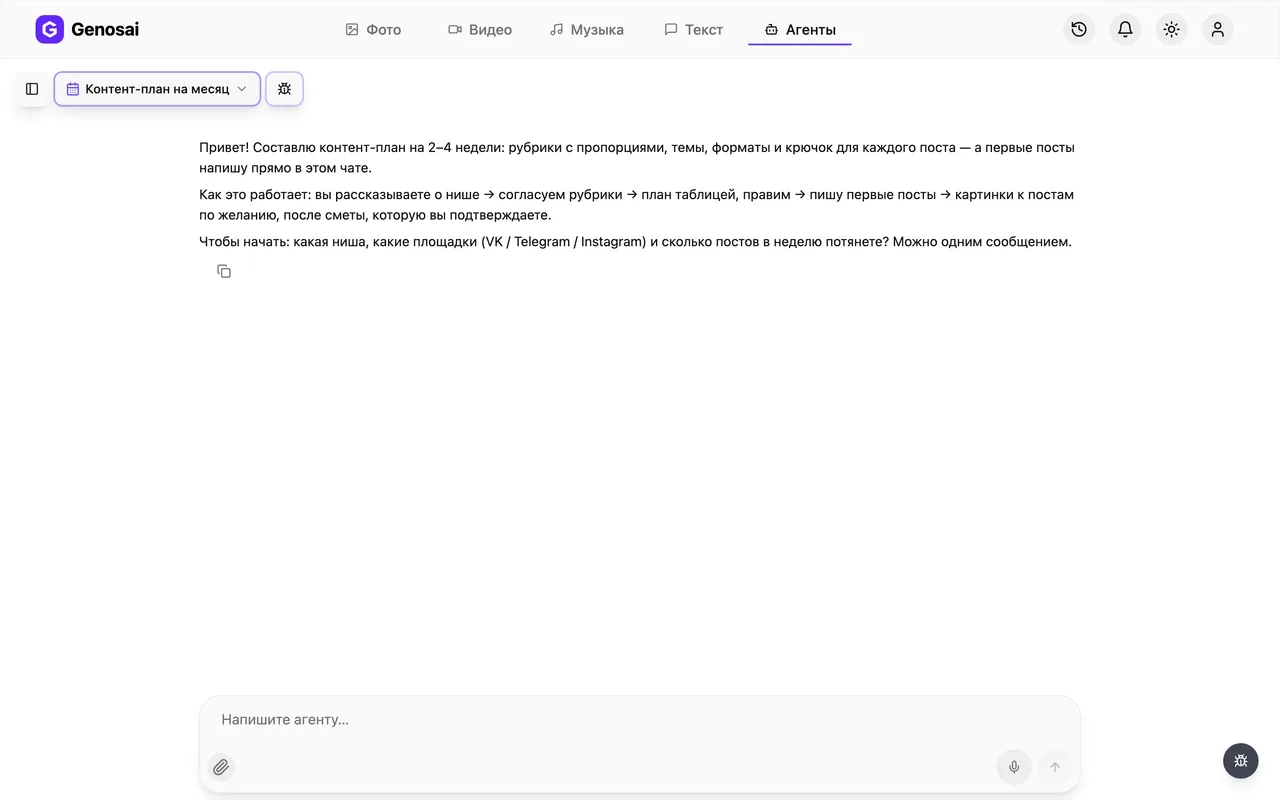
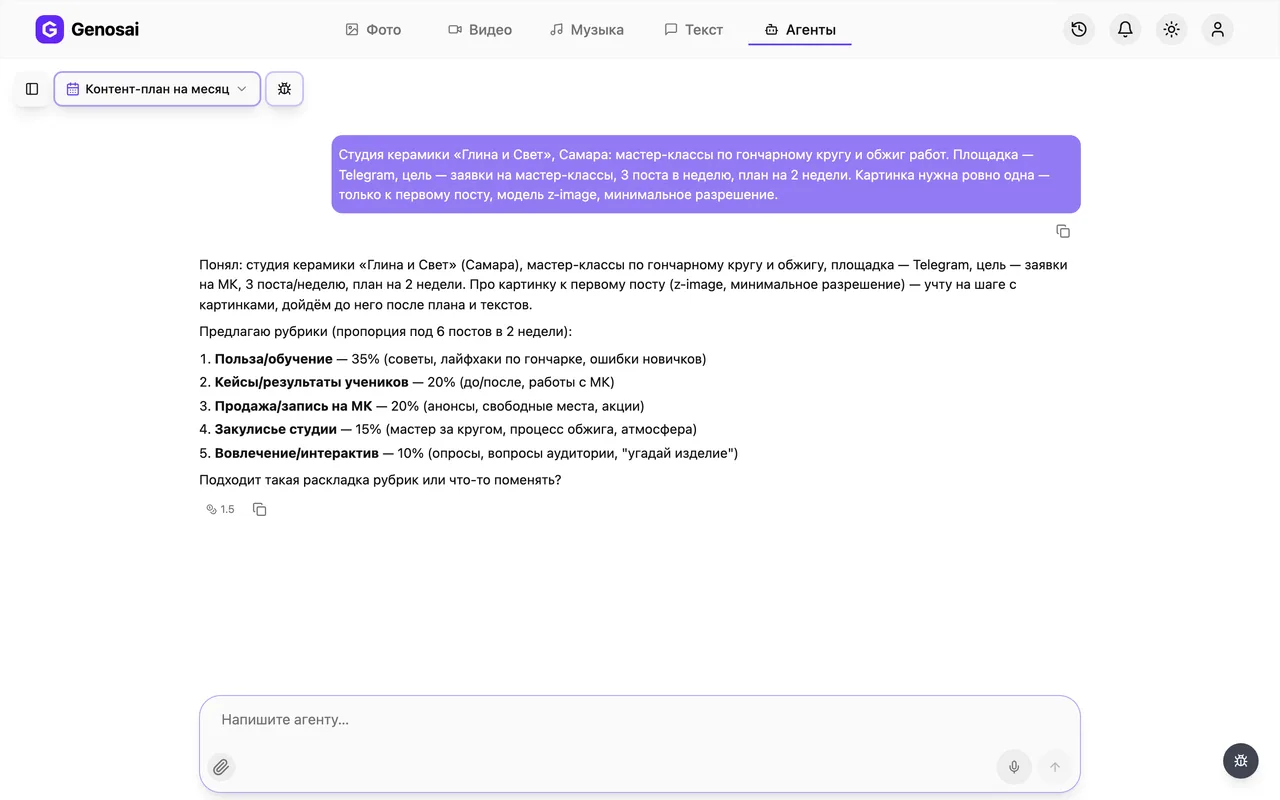
The agent writes first and immediately asks the essentials: your niche, where you publish and how many posts a week you can realistically manage. One message in everyday words is enough and nothing has to be prepared beforehand.
5. Step 5. Answer and approve the rubrics
Describe your business, your platforms, your goal and the length of the plan, two or four weeks. The agent proposes four to six rubrics with proportions, for example forty percent advice and twenty percent cases. Say what to drop or add and it rebuilds the set.
Discussing rubrics and editing the plan costs very little, so argue here rather than after images are drawn.
6. Step 6. Get the plan and the first posts
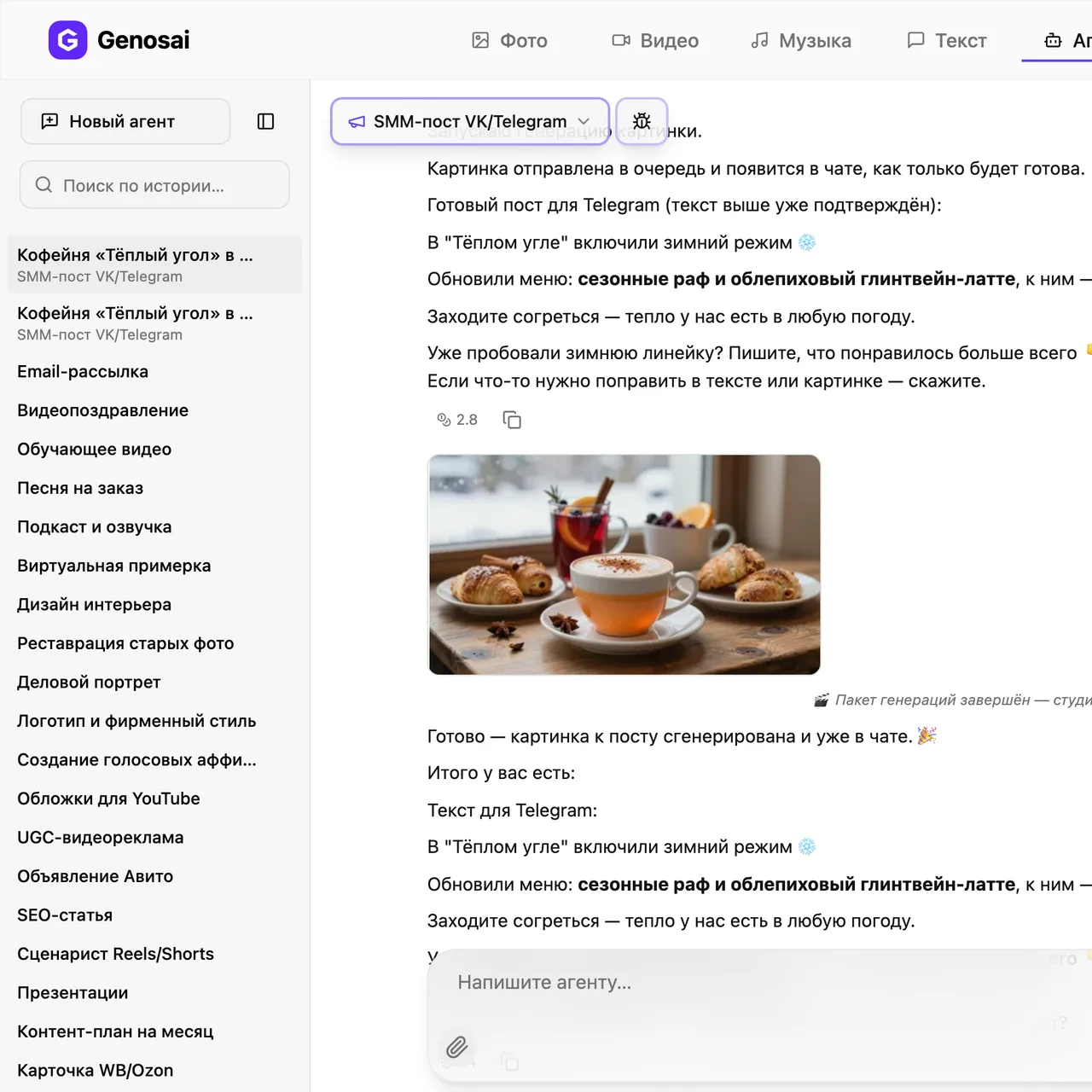
The agent prints a table with the day, rubric, topic, format and opening line. Edit it as much as you like, then ask for the first posts and it writes them on the spot. The conversation is saved in the list on the left, so you can come back to the plan all month.
7. Step 7. Order images and confirm
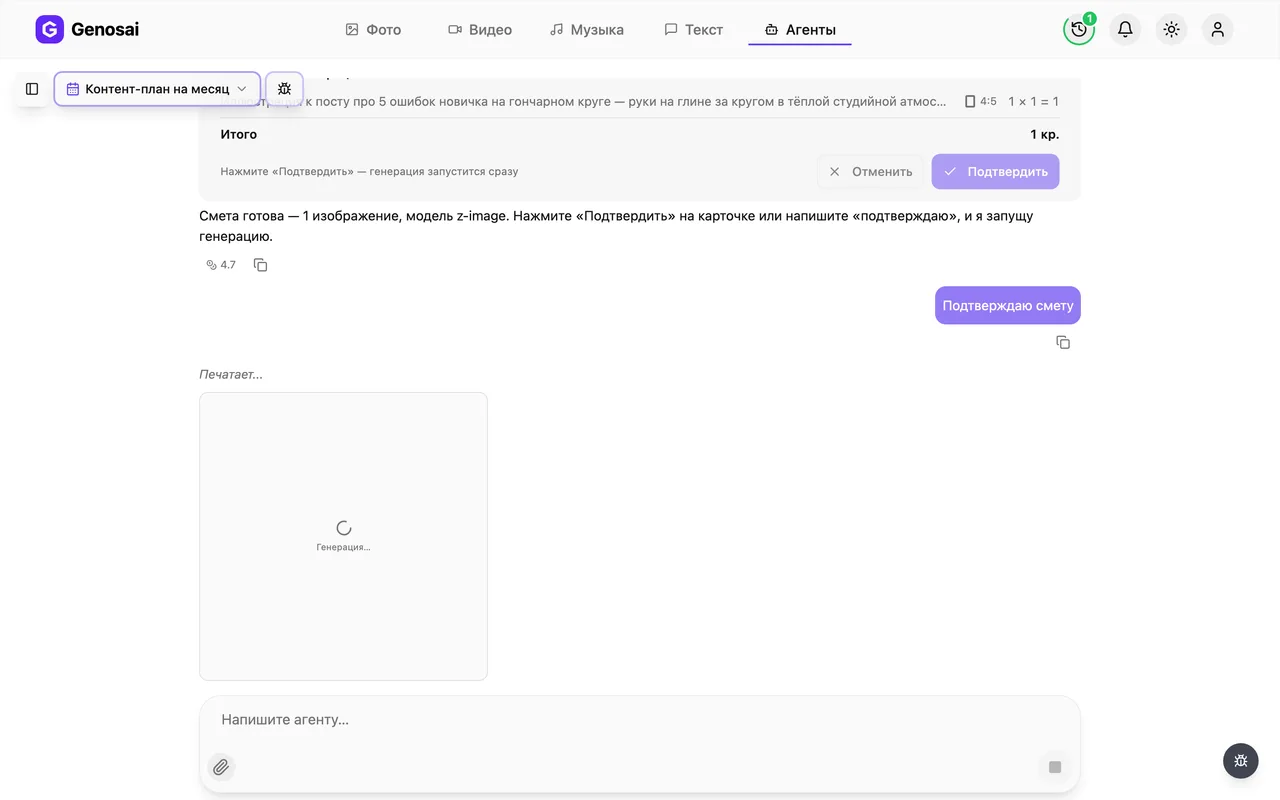
Say which posts need illustrations, for example the first three or all of them. The agent shows an estimate card with the number of images and the cost in credits. Nothing is charged until you press the confirm button.
A long yes that all looks right does not replace the button. Press confirm or write the single word confirm.

8. Step 8. Wait for the drawing
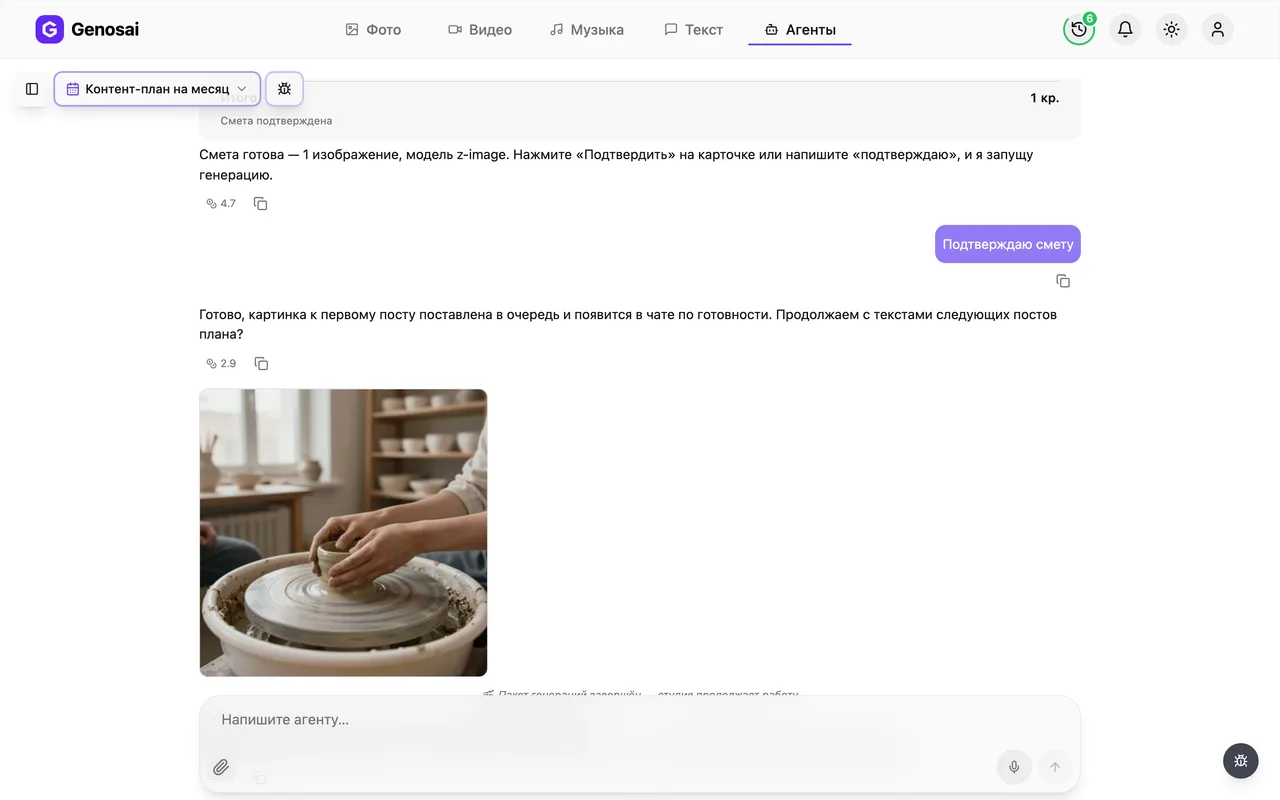
All images are drawn in one run and tiles labelled Generating appear in the chat, each turning into a picture as it finishes. With more than six pictures a readiness counter is added above them. Several pictures take a couple of minutes. You can close the tab and return later, the work will not stop.
9. Step 9. Collect plan, posts and images
Copy the plan table from the chat into your notes or a spreadsheet, take the post texts from the quoted blocks and save the pictures one by one by clicking a picture and using the download icon in the full screen viewer. From there you simply publish on schedule and return for the next posts.
What this agent does
A content plan answers the question that torments every page owner: what do I post today. Without a plan you sit down in the evening, stare at an empty field for ten minutes and postpone the publication. With a plan you open a table and see the topic, the format and the opening line.
The agent builds that plan with you in a sensible order. It starts by asking about your niche, your platforms, your goal and your realistic pace, meaning how many publications a week you can actually sustain. Then it proposes rubrics with proportions, for example forty percent advice, twenty percent cases, twenty percent selling and twenty percent behind the scenes. Those proportions matter more than they look: they are what keeps a feed from turning into non-stop advertising or, in the other direction, into a free magazine that never offers anything to buy.
Once the rubrics are approved the main table appears: day, rubric, post topic, format and the hook for the first line. You edit it in ordinary language until it feels like yours. After that the agent is ready to write the first publications in the chat and, if you want, draw matching images in a single shared style.
Who it is for
Small businesses that run their own social accounts. A salon, a coffee shop, a workshop, a neighbourhood store. These pages have no dedicated specialist, yet they need to publish constantly.
Independent experts. For a therapist, a lawyer, a trainer or a tutor the plan works as an editor: it removes the painful choice of topic and turns publishing into a routine.
Newcomers to social media work. The first thing any client asks for is a plan. The agent hands over a ready structure that you defend in the meeting and fill with the client facts.
People who tried running a page and quit. They usually quit not out of laziness but because every post started from zero. A plan removes exactly that reason.
If the plan already exists and you only need text, go to the VK and Telegram post agent. For topics that work better swiped than read there is the Instagram carousel.
What to prepare in advance
No files, no spreadsheets. Five answers are enough.
Your niche and product. Not simply beauty, but a nail studio in a residential area with an average ticket of forty dollars.
Your platforms. VK, Telegram, Instagram or several at once, since this decides which formats appear in the plan.
Your goal for the coming month. Gaining followers, collecting enquiries, or warming up people who have read you for ages without buying.
Your pace. How many posts a week you can genuinely handle. Two done steadily beats five done for three days.
Your specifics. Seasonality, upcoming events, services you must sell, subjects you never touch. A couple of sentences is enough to stop the plan from feeling like a template.
Walking through a real conversation
Here is a shortened exchange showing how it works in practice.
Agent. Hi. I will build a content plan for two to four weeks with rubrics, topics, formats and a hook for each post, and I will write the first posts right here. What is your niche, which platforms do you use, and how many posts a week can you manage?
You. A nail studio in a residential area. Telegram and VK. Three posts a week, plan for four weeks. Goal is bookings through direct messages.
Agent. Understood. Here are the rubrics with proportions.
- Advice and hand care, 40 percent.
- Work shots and client reviews, 20 percent.
- Selling and booking, 20 percent.
- Behind the scenes, 20 percent.
Does that work or should I change something?
You. Less behind the scenes, and add answers to common questions.
Agent. Rebuilt. Here is the four-week plan.
| Day | Rubric | Topic | Format | Hook |
|---|---|---|---|---|
| Mon, week 1 | Advice | Why polish chips after three days | Post | It is almost never the polish |
| Wed, week 1 | Questions | Can you get a manicure with allergies | Post | We hear this one every week |
| Fri, week 1 | Work shots | Nail recovery after extensions | Carousel | Before and after, no filters |
| ... | ... | ... | ... | ... |
What should I change?
You. Move the selling posts to Friday, people book before the weekend.
Agent. Done, selling now sits on Fridays. Shall I write the first three posts from the plan now?
You. Yes, please do.
Agent. Here is the first one, then we go in order.
> It is almost never the polish. When a coating chips on day three, the preparation of the nail plate is usually to blame...
You. Good. I need images for those three posts.
Agent. Here is the estimate for three images in one style. Nothing is charged until you press confirm.
You. Confirm.
Agent. Starting now, all three pictures will appear here in a couple of minutes.
Note one thing: agreement to the estimate has to be short. A phrase like yes of course go ahead is deliberately not treated as confirmation, so that money is never taken because of a casual remark.
What it costs
There is no fixed price. The cost depends on the volume of work and the agent shows the exact figure in the estimate before starting. Nothing is charged until you press confirm.
The plan itself and the post texts come out of the conversation, which is billed separately at a negligible rate. In practice that means a full month of planning, including edits, costs you very little.
Visible spending appears only when you order images. The guide is simple: a batch of illustrations costs roughly the same as the same number of ordinary image generations. Three pictures cost like three generations, ten like ten. They are all drawn in one run, which is why the style matches.
If one of the images fails, its credits return automatically and the agent redraws it without a new estimate.
Common beginner mistakes
Setting an unrealistic pace. Someone declares seven posts a week and disappears after ten days. Start with two or three and grow once the rhythm is there.
Describing the niche vaguely. We sell home goods produces a dull plan. Explain who your buyer is and what they ask before purchasing.
Building a plan made only of offers. If every second topic is a discount, readers unsubscribe. The rubric proportions exist precisely for this, so do not break them without a reason.
Editing after the images are drawn. Changing topics once illustrations exist is expensive, because it means new work and a new estimate. Have those arguments while the plan is still a table.
Losing the plan. People close the tab and assume everything is gone. The conversation is kept in the history, but copying the table to your own notes is safer.
Why this beats planning it yourself
Planning on your own usually eats an evening and ends with five topics before inspiration runs out. A social media specialist charges a noticeable fee for a monthly plan and needs several days to deliver it. The agent produces a complete table in ten minutes and reworks it as many times as you ask.
The second gain is that the plan is immediately usable. It contains not only topics but formats and opening lines, so writing a post starts from a hook rather than a blank page. That blank page is the single most common reason people stop publishing.
An honest limitation: the agent does not know your company or your statistics. It has no idea that last month the post about one of your staff performed best, and it cannot see your reports. Treat its plan as a solid foundation that you enrich with your own facts and observations.
Agents that pair well with this one
A plan is most useful when other helpers turn it into finished publications.
Texts for the planned topics come fastest from the VK and Telegram post agent. Topics that beg for a swipeable format go to the Instagram carousel. Ideas for short videos become scripts with the Reels and Shorts scriptwriter. When a topic grows into a large article for your website, the SEO article agent writes it, and mailings to your customer base come from the email newsletter agent.
Every helper in the service is listed with its purpose on the all agents page.
FAQ
How long a period does the plan cover?
Two or four weeks, whichever you choose. Beginners usually do better starting with two weeks, seeing which topics land, and only then planning a full month ahead.
How many posts a week should I plan for?
Be honest about your capacity. Someone working without help usually manages two or three posts a week. A plan with seven looks impressive and is normally abandoned in the second week.
Does the agent only plan or does it write posts too?
Both. It first builds the plan as a table, then writes the first publications in the chat on request. The rest can be written later in the same conversation or handed to the dedicated post agent.
Can one plan cover several platforms?
Yes, name them all in your first message. The agent accounts for format differences and suggests which topics work better as a plain post, a carousel or a short video.
What if the proposed rubrics do not suit me?
Say it in words: remove the personal section, add customer reviews, fewer selling topics. The agent rebuilds the set and shows new proportions. Edits at this stage cost only pennies.
Is there a separate charge for the plan?
The plan has no price of its own, since it emerges from the conversation, which is billed at a negligible rate. Real spending starts only when images are drawn and only after you confirm the estimate.
How do I avoid losing the plan after closing the site?
The conversation is stored in the chat list on the left and you can reopen it any time. For safety, copy the table into your notes or a spreadsheet on your computer.